Archive for the ‘TECHNICAL’ Category


Fly Fishing the Chisolm Trail

Lake Nocona Largemouth Bass in springtime
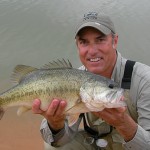
Lake Nocona largemouth bass caught on fly in April along the shores of Lake Nocona.

The first thing that comes to mind when Texans mention Nocona is boots. I’ve got some, and if you are a boot wearing Texan, chances are you have a pair too. Nocona makes good boots, and Nocona also has an interesting lake by the same name.

HISTORY OF NOCONA TEXAS
Nocona isn’t named after boots. It’s named after Peta Nocona, chief of Noconi band of Comanches, and father of Quannah Parker. Nocona is the last stop on the Chislom Trail before crossing the Red River into Oklahoma.

The other name synonymous with boots is Justin, and in an interesting twist, the origins of Justin boots can be traced and tied to Nocona as well. Regardless of the boot industry, Nocona is another of those towns, where the west begins, that not surprisingly owes its existence to the railroad.

About fifteen miles north of Nocona, near where Salt Creek enters the Red River, is the Red River Station – the actual place where cowboys moved their cattle along the Chisolm and across the river.

The lake is a hybrid itself, combining two segregated areas – one public access, and the other private gated communities.

One thing you will always find is that a more concentrated population also brings much more concentrated wear and tear on those areas deemed public. And Lake Nocona is no exception. The trash and filth along the public areas is phenomenally bad. I make a pretty concerted effort to look past all the trash wherever I go (and pick up as time allows), but we’re talking hypodermic needles, broken glass, monofilament … on, and on. I am guessing that it’s hard to get folks together and clean up their meager public access areas when they look across the lake at the huge lake houses … it’s a place where the public areas are certainly used by the 99-percent while the 1-percent appear to own the best 90-percent of the lake.

Crownover pier at Lake Nocona Texas

Lake Nocona is also extremely low, and that also has a tendency to expose trash that was lurking just under the surface. It also makes walking easier, and kayak fishing a much more attractive proposition.

Texas indian paintbrush wildflowers near the shore of Lake Nocona

The topography of the lake is varied, with naturally rocky points, a rip rap dam, coves and emerging points that can make power boat navigation a challenge. Otherwise, there’s plenty of open water on a lake that covers 1,323 acres. The water is pretty clear, and submerged vegetation is already pretty dense. I did locate a few fish in the backs of coves, but most of the flat cove habitat is lacking in bedding that bass desire.

What I did happen onto, was a point where young pound to pound-and-a-half largemouth bass were schooling and shredding baitfish. There haven’t been a lot of times that I have been able to experience large numbers of schooling largemouth bass, but it was an experience I won’t soon forget. These fish were very wild, green and full of fight. They fought pound-for-pound as good as the best largemouth bass I have ever caught.

Although their sizes were virtually identical, these fish were surprising in their ariel displays, long hard runs and sheer determination to win. It took me awhile to get over the typical four to six huge jumps I got from virtually every fish, and settle into a calm battle royale. After catching about fifteen of these mean green bass, I had all I could take, and called it a day.

On subsequent visits to Lake Nocona, between shifts, the crappie were also in full spawn and found quite easily in the back ends, and deepest portions of coves. A slow drag of a Clouser minnow – bright colors like white over white with lots of silver flash – proved deadly to the count of two to three dozen crappie on each outing.

Lake Nocona Texas crappie caught on fly rod

Part 2 of On The Road: Fly Fishing Lake Nocona Texas will highlight the other things to see, Texas history, near Lake Nocona.

Publisher’s Note – I wish all the Mom-and-Pops had schedules like Living Waters located in Round Rock, Texas! Chris Johnson is building a base the right way, with knowledge, action and adventures.

“Things have been busy at the fly shop and we have been more than pleased with all of the fishing reports that have been coming in from our guide trips and customers alike. If you haven’t been out to Brushy Creek lately, then you are missing out on some of the best fishing it has to offer! We have been catching a variety of different species throughout the hill country, in fact in the last month we have brought over a dozen different species to hand with shots at many others. If you want to see a fishing report for a certain body of water that we guide, simply visit our website at www.livingwatersflyfishing.com, and click on the fishing reports in the bottom right corner of the homepage. Below is a listing of our upcoming events for the rest of April and all of May. As always, if you have any questions, just call the fly shop at (512) 828-FISH. Take care and God Bless! — Chris Johnson

May 2012

5/2, Wednesday — Fly Tying Night @ Living Waters Fly Fishing
We meet at Pok E Jo’s BBQ in Round Rock for dinner at 6pm and then meet back at LWFF at 7pm for tying.

5/9, Wednesday — Fly Tying Night @ Living Waters Fly Fishing
We meet at Pok E Jo’s BBQ in Round Rock for dinner at 6pm and then meet back at LWFF at 7pm for tying.

5/10, Thursday — Living Waters Afterhours (Workshop) — Targeting Rio Grande Cichlids
Living Waters Afterhours is a standing event that will be held on the 2nd and 4th Thursday of every month from 6:00 P.M.-8:00 P.M. — the event is completely free of charge. The 2nd Thursday of every month will be a fly fishing worshop where we will key in on one specific topic such as this month’s: Targeting Rio Grande Cichlids. We will cover fly selection, fish location, presentation, and more. We will will dicuss each topic in great detail and there will be plenty of time for questions during and following the presentation. If there are any questions, please call the shop at (512) 828-FISH.

5/12, Saturday — 10:00 A.M. — Alaska Presentation by Rus Schwausch of EPIC Angling & Adventure
Alaska Peninsula Fly Fishing Camps
Owner Rus Schwausch and head guide Ted Mendrek of EPIC Angling & Adventure will present two remote Alaska Peninsula operations. Alaska Wilderness SAFARI, the more sophisticated option, is written up in the book Fifty Places to Fly Fish Before You Die as “arguably the most isolated coastal fishing camp in Alaska and one of the best places in the world to pursue chrome-bright, ocean-fresh salmon.” And there’s a lot more to do than just fish – daily wildlife viewing, hiking, waterfalls to see and tide pools to explore. Alaska Wilderness OUTPOST is a rustic, early season camp offering excellent small stream fishing for rainbow trout, grayling, king salmon and more. Short on frills, this program is for the die-hard fisherman focused on quality fishing rather than extraneous amenities.
You can find out more about these operations at www.epicanglingadventure.com.

5/12, Saturday — 2:00 P.M. — Beginning Fly Tying Class
Instructors: Chris Johnson and Matt Bennett
When: Saturday, April 12, 2012, 2:00 P.M. – 4:00 P.M.
Where: Living Waters Fly Fishing
Skill Level: Beginner
Cost: $50
If you have ever wanted to begin fly tying but just needed someone to show you how, this is a class designed with you in mind. Matt and Chris will be teaching the elemental basics of fly tying and will help you build solid fly tying foundations that will last a lifetime! All vises, tools, and materials will be provided. Class size is limited to 6 students. Cost is $50 for the two hour class. Call (512) 828-3474 or email to reserve your spot today!

5/16, Wednesday — Fly Tying Night @ Living Waters Fly Fishing
We meet at Pok E Jo’s BBQ in Round Rock for dinner at 6pm and then meet back at LWFF at 7pm for tying.

5/19, Saturday — 10:00 A.M. — Fly Fishing Brushy Creek – Round Rock’s Home Water
Presenter: Chris Johnson
This presentation will cover access, techniques, fly selection, hatches, species availability and much more — and all as it pertains to Brushy Creek! This little creek is Round Rock’s premiere fly fishery and can be incredibly productive when fished correctly! Come and learn some of our guide secrets and get an eye-full of fish pictures — Bring a notepad/pen as there will be plenty of time for questions and answers!

5/23, Wednesday — Fly Tying Night @ Living Waters Fly Fishing
We meet at Pok E Jo’s BBQ in Round Rock for dinner at 6pm and then meet back at LWFF at 7pm for tying.

5/24, Thursday — Living Waters Afterhours (Fishing) — April Location: Memorial Park in Round Rock (Brushy Creek)
Living Waters Afterhours is a standing event that will be held on the 2nd and 4th Thursday of every month from 6:00 P.M.-8:00 P.M. — the event is completely free of charge. The 4th Thursday meeting is held on the water at a local fishery of our choosing that will be announced in advance. (once the time change in the fall shortens the days, instead of meeting on the water, we will meet in the shop for tying/fishing clinics until spring rolls back around with longer daylight hours). This time is designed to help increase your general knowledge base of certain fishing techniques and situations. In May, we will meet at Memorial Park in Round Rock (Brushy Creek) to fish at 6:00p.m. and will fish until dark-thirtyish. Matt and Chris will be available to help “guide” anyone who desires coaching in fly selection, presentation, and sight fishing. This is designed to be an on-the-water learning experience and we hope to see you there! If there are any questions, please call the shop at (512) 828-FISH.

5/26, Saturday — Rep Day with Eric Kraimer
Eric is our Simms, Scientific Angler, Ross Reels, BUFF, and Rainy’s factory rep. If you ever wanted to know all about the products we carry or learn the finer details of a certain product, then all you need to do is ask Eric — he knows his stuff and is very informative! We are looking forward to having him at the shop and hope to see all of you here. (Full event info will be posted on the website)

Ostriches in your backcast are only one of the possibilities in this pond fly fishing  action.
Talk about challenging! Try to remember an ostrich, emu, or yak can show up in your backcast any time.

I stuck my finger in my ears, one at a time, rotated to check for wax and pulled my finger out with a pop. Nope, clean as a whistle. “You need me to tell you what’s in your pond?” I could hardly believe my ears.


The biggest greenie I have ever caught. Heck of a beautiful fish that can wreak havoc in a pond’s delicate balance.

The pond came about as a place for Joe to let his Dad and Granddad wet a line. It has a couple of deep holes and a good amount of surface area. Along the way fish caught elsewhere made it into Joe’s pond, but they hadn’t been seen in awhile. Thus the mystery that needed solving.

Joe wanted to know what he had and what he needed for his pond. I figured I knew just enough, from paying attention to experts on pond biology and fish stocking, to be able to at least provide an educated guess on what was going on under the surface. The last thing Joe had to report on his pond was that a recent flash flood had come through and left a five pound largemouth sacrificed on a nearby fence.

Thin largemouth bass is a sign of a problem.

Other than that, there were a few other variables running around in the pasture where Joe’s pond is located. A full size ostrich, a flock of emu and a couple of yaks could show up at any time to do quality assessment of my backcast, and didn’t mind digging through any bags of gear left on the ground as I wandered off into bliss.

My first trip to evaluate the pond was earlier last week, and I had arrived late in the evening and managed only a few minutes of evaluation once my adrenalin settled from the face off with two friendly feisty yaks. I apologized for having their relatives hair in my fly box, and they calmed down a bit.

My first cast caught a largemouth that ran about a pound-and-a-half, and just about every cast lead to largemouth from six to fourteen inches in length. They all appeared to be males, and they had nice bellies (probably because Joe had several pounds of minnows put in the day before.

Joe told me the water is very clear typically (we were being assaulted by serious winds), and the main water source was drainage from the pasture and in extreme rains – water comes from across the road, down a ditch and finally rushing into one end of the pond. That end was rendered pretty shallow and muddy, but I caught fish there as well.

The clarity combined with the thick green slime along most of the shore, lead me to believe the pond could be suffering from an abundance of nitrogen. Drainage off the homes across the road and the abundance of animal life in close proximity seemed like it could be the cause. In the long run these problems can lead to a fish kill due to oxygen deprivation.

DAY 2

On day two, I was able to take Joel and his son out to Joe’s pond, but instead of disclosing all the details, I created a surprise for his three-year-old that he’s not likely to forget anytime soon – birds, a camel, deer and a menagerie of animals left him wide-eyed and speechless.

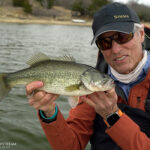
A happy pond fisher with a largemouth bass.
The tough guy look from a proud fisherman.

I knew Joel was needing a fish fix since his promotion to associate principal of his high school, and we all know what a day of catching can do for a three-year-old’s outlook on the sport of fishing. Throw in a demonstration of the strength of ostrich eggs (I stood on one), and I am thinking this day will be etched in his memory banks for awhile. Ponds are the cure for all that ails us.

Two fish on the first cast basically set the tone for a frenzy of catching fish, shooing away prehistoric looking birds with evil eye stares, and battling another stiff wind with fly rods.

For Sunday’s test, I went to a smaller black woolly bugger in hopes of catching smaller fish that we could learn from as well. Nothing doing. Bass attacked, but I was finally able to filter through them and catch a coupe of huge greenies on that same bugger. The term “huge” may not be scientific, but when I say huge I mean huge. They were larger than the palm of my hand and every bit as hard a fight as any largemouth bass – the largest I had ever caught.

Unfortunately greenies really like to raid largemouth bass beds for eggs and compete directly with largemouth for food resources. Greenies this size could be a troubling thing for the pond’s balance, and Joel recommended a future release into grease for any caught.

His assessment included the observation that there were no females caught, and we both realized that the larger bass we caught were actually thinner and more disproportionate than the smaller bass. It’s one of those wicked problems that requires some tough love – culling. Fortunately, there are a few ponds on Joe’s place, so an aerated bucket would save those unlucky enough to be caught. In this instance a cull wouldn’t be a kill, a real best case scenario. There’s still the question of the depths of Joe’s pond, and before I can produce a final opinion on the population in the pond, I will have to have some calm weather and different options for fishing the depths of Joe’s pond.

We hopped aboard Joe’s chariot and headed back to the barn where Joe’s camel was hanging out. Just another day in the wilds of Texas.

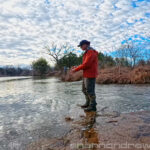
Joe's pond.
Joe’s Pond near Krum, Texas.

ADVERTISERS

Popular Topics

Earth and Moon

CURRENT MOON PHASE

Fish Feed

Send In Your Fish Photos!

LIKE THE FREE CONTENT?
Stick a Dollar in the Slot and get More.


Who's Online

  • 0 Members.
  • 7 Guests.

SEARCH TFC

Bad Behavior has blocked 1259 access attempts in the last 7 days.

Bulk Email Sender