
Archive for March, 2009


I made may way up the shoreline, one of those flats shorelines you fall asleep at night reading about – six inches of water, gin clear, edged by tall grass, and alternately sandy muddy bottoms – ultimate waterscape for flats Redfish. I was beginning to find my eyes, and be able to discern the differences between mullet, Sheepshead and Reds. I was beginning to see some Reds, mostly in raging retreat from my less than optimal stalking skills. It was time to get inside my own head. I had spent countless hours imagining every Carp I was stalking back home was a Redfish I was stalking here, and now it was time to reverse roles – slow everything down. I imagined myself back home fishing for carp, slow quiet, no blind casting … watch and wait, sight and cast.

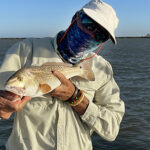
Thirty feet ahead, and about ten feet offshore, were two nice Reds cruising toward me about three feet apart. They were doing that simple lazy swim. My Clouser hit sweet and soft, but about two feet to the left of the nearest fish. I gave it a couple of quick twitches to see if he would catch a glint … baby twitches … and to my surprise he turned and took. The first run was a freight train that went within five feet of the backing before I summoned the courage to see if everything would hold and I could turn him on my eight weight. This was what I was here for, and the excitement of doing it yourself, and getting it done, created quite a rush. But we all know one of the quickest ways to crush a rush is to have one respectable fish get away. Add to all that, the fact this fish was blatantly going to be the best Redfish I had ever caught, and I played him like he was on 6X tippet and a two weight rod. Two more good runs, and I lipped him with the Boga. He weighed in at a bit more than 3.5, and looked to be a long lean twenty-six inches. I shot some of the crazy video you’ll see, and released him to swim away leaving a wake for about twenty yards. Right there and then, thinking about spending another night in the car, I was ready to go home. After about four hours of looking, trying different flies – at least I knew what fly would work. It is difficult not to feel dumb for not trying that particular pattern earlier. After all, I had tied it just hours before I left – on a hunch. I only tied two of the pink-and-whites, so their value suddenly increased exponentially – even if I had everything I needed to tie some more.

By the time I did a 180 to head back to the kayak, I was probably a thousand yards from the kayak, and nowhere near the end of the cove. I knew it was time to move out, and wanted to check the channels between the shell banks again. It was obvious that, as I passed by, Reds were moving in behind me, so I fished my way back until I saw, at about 100 yards in the grass (a little beyond where I had caught my Red) – a six foot alligator. So this was how it was all going to end. I was in the water, and he was pointed nose out … sunning and I hoped, prayed – fed. First order was to shoot some video – maybe someone would find that and figure out what happened. Then I summoned all I knew about alligators. They’re fast in a straight line, they consider themselves vulnerable on land, and killers in the water. Note to self – read up on alligators if you make it home alive. I was within his sight, and too far away from shore to take a wide land route around him. Besides, there could be more or a nest or something worth protecting on the shore. I walked deeper and deeper into waist high water, but two hundred yards away from his nose. My imagination saw a World War II torpedo coming straight for me, bubbling and screw turning, but this was a gatorpedo. What would I do if that happened? I decided I would break my rod above the handle, wait until the last possible moment and jab him in the mouth.

He never moved. I arced back toward shallower water, and about 150 yards of wading to the kayak – not fishing – wading briskly. I hopped in and was off quietly and … quickly. Maybe I overlooked the part in all the promotional web sites about alligators, but yes there are alligators. At least carry a big knife with you, and beware of your surroundings at all times. I later heard a story from Jon (54Bravo), about a man who I had seen that day out in a tandem with one of his kids, and the other in their own kayak, obliviously heading into a cove Jon knew had a gator sunning in it. Apparently, gator hisses were followed by screaming and large boat wakes left behind their kayaks as they headed for open water.

I found myself what appeared to be three miles away from the pier, and with just enough time to backtrack, and hit one deep cut between two shell banks. It seemed like a great ambush point, so I landed and gave it a go with a fly that I knew would work – and it did. I caught one Rat Red, and knew I was done for the day. I was feeling the kinks of sleeping in the car, paddling an estimated six miles, and casting an eight weight virtually all day. And the day never ends until the kayak is back on top of the car, and everything is accounted for and loaded.

I headed back to the ranger station to see if any sites were available, and to my complete surprise three tent sites in the “wooded area” were available. The park lady may have laughed at me earlier, but now I was laughing at the idea of stretching out – full length – and sleeping. I staked my claim between families of screaming kids and partying parents. None of that would make a difference, anyway, I knew I would sleep like a dead man, thankfully not in a gator’s belly.

With the idea of a good sleep looming, I needed to see what Rockport was really all about. It has all the characteristics of a town half alive, half dead and fully capable of being a big time destination. There are the older parts, with storm worn buildings, some abandoned, and some still in use, but all with a story to tell – be they brightly painted bait stands, or carnival curiosities like the two-thousand pound fish. Although March is obviously not prime-time for Rockport, the are ready for summer prime-time with Wal-Mart, HEB, and all the varieties of fast food you could expect in a Texas beach town. All of these conveniences are just across the bridge from GISP. The area around the marina is clean and well worth the walk that leaves one relaxed and ready for something exciting, or just another day of the same. From what I could tell, there may not be a depth of entertainment for your female S.O.’s , but if relaxation is key – Rockport should be on your destination list.

I had a pretty good idea of where Bravo54′s site was back on the peninsula by the pier. Bravo54 now had a name – Jon, and I was glad to have met someone who knew more about this area than I did. If you are looking for some information about an area, you would be well served to add Texas Kayak Fisherman’s web site to your list of resources. We made plans for the next day, I went into town to eat – a lot, and back to my tent to sleep – hard.

The next morning I woke up to a fog so heavy you could squeeze it in your hands and wring the water right out of it. Visibility zero. I headed out to the peninsula where Jon, the Doctor (a PhD. that Jon just met) and myself loaded up and headed for the opposite end of the peninsula. Jon had an idea that there would be fish behind the new rock breakwaters – laid to create new wetlands. We definitely wanted to stay out of the waterways (until the fog cleared) because we knew some guides would be flying by GPS, and never know what that little bump was.

The lagoons formed by all the construction looked as if they would be very productive, but a combination of visibility, tide and extremely deep mud, made for impossible conditions. One strange sight, in the middle of nowhere, was the cross made from what looked like stainless steel drill stem.The waiting game – for the fog to clear – went on until after noon.

Once the fog cleared, we headed out for some spots Jon was familiar with, one of them being that same place with the cut between two shell banks. I beached and began casting into the gut with full confidence in the fly from yesterday. I caught a couple of small Rat Reds, and noticed Jon was working his way to the east. By the time I had pounded that spot pretty solidly, he was a good half mile away. I paddled off in that direction, made a few stops, and he was further away. I glanced over to see if he would signal, and he flew up a paddle and waved me over. There were some reds cornered, and feeding where the wind was blowing food up into a ninety degree corner where some sand jutted out. Jon gave me the spot, and I hit it. A nice fourteen inch Red finally took, and wetted the appetite.

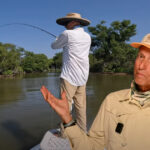
I saw some grass outcroppings further to the east, and decided to wade my way to see if the grass held any fish. Jon, who obviously spends a lot of time on a kayak, loaned me a ski pole he uses for a stakeout anchor – drive it down through the scupper and into the mud, and it’s set – and I was off to beat the bushes. It looked so promising, and there were Reds I missed, zooming past me after I missed them, I kept hopping down the shoreline from clump to clump. At the next to last clump, a Red stirred out of the grass from less than three feet, went about five feet toward shore, and … stopped. So now I’m looking at a Red less than a rod’s length away. I pull the rod up behind me and direct drop less than six inches from his nose. No leader, and no line in the water. Just like yesterday, it was a strong and confident take. This Red (the second one on the video) weighed in at the same as yesterday’s fish, but a shorter fatter 22 inches. My day was made.

We headed back in and met up later. We went to Pop’s Place for a recap of the days events, and to admire the bottle cap Speckled Trout and Redfish over the average chicken fried steak and above average beer. Pop’s, on Park Road 13, is a must see blend of locals and oblivious outsiders clad in their Tommy Bahamas. I knew it was over for me this time; I had gone too hard, too many hours, and not had one extra day (or half day) needed to put a cushion of relaxation between fishing marathons. No recovery time means no mas.

I took in another dead-man’s night of sleep, and awoke to another soupy morning. I decided to use the fog for some photography, but forgot to get a look at the Big Tree … always leave a reason to go back I tell myself. Sometimes, the weather being “bad” is actually good; it makes you have to think and adapt, and nine out of ten times it produces images that are anything but typical. The airboats, skiffs and flats boats were still fogged in, and the trees became shapes – less a living function, and more a looming form.

Perusing the aisles of the fishing tackle store, I found the right ball cap for LK’s standing order, and a tee shirt for myself. Rockport Tackle Town was a study in supply and demand. The demand here is for just about everything but fly fishing, and supply reflects demand in economic perfection. I double checked the obvious – if you’re looking for a guide give Rockport Tackle Town a call at 361-729-1841, and tell them where you heard about them. I paid my way out, and headed north on 35 back across the Copano Bay bridge and home. It wasn’t fast or furious, but for the middle of March, a couple of nice Redfish, and learning the water could be considered outstanding results for another completely solo DIY trip.

POST SCRIPT – If you want GPS coordinates, links or other information (as if I left something out!), feel free to ask, and ye’ shall receive.

.

Goose Island State Park Pier
One of the places to launch from, and fish from at night – the Goose Island State Park Pier.

It all started to come together as I was passing across the Copano Bay bridge back into Rockport. The sun had finally beaten back the fog inland, a distinct wall to the west, and the indistinguishable line between sky and water had given way to a third pristine day. The common retort pointed to the “fly guy”, the only fly guy around, was “man, you got lucky – perfect weather – no wind!” I knew they were right. After all, I am a Valley Boy, and know the wind blows all the time.

I stopped at Rockport Tackle Town not knowing what to expect, but airie with whatever I found, as the Gulf air flowed between my ears carrying away my troubles like a slow inshore tide. I knew I had to check out the store, and see what the apparent epicenter of fishing supplies for Rockport had to offer. As I walked in, it was plain to see they were a balanced business of typical fishing gear, tourist trinkets and tee shirts that provide the real profit margins. Fly tying supplies were sheepishly stored on some pegboard, dead center at the back, nothing there that screamed; “The Missing Ingredient!”.

Laid back. Those were the words I encountered most when I mentioned Rockport, Texas, as a potential destination for a short trip to see if a DIY for Texas Gulf Redfish would be practical. The first two places that came to mind had their own downsides, the danger factor at the Sabine Pass area, and the impracticality of being boatless in Port O’Connor, Texas. Sean Polk, at Orvis Dallas, pointed me toward Rockport as a place that was custom made for kayak fishing and it sounded like it was off the radar enough to minimize the spring break crowds.

And there were crowds – driving toward Rockport the highways were loaded with spring breakers, usually two-by-two, a driver at the wheel from some corn state, and a passenger asleep with their favorite pillow from home wedged against the window sound asleep. It was one of those annual migrations, much like bird migration patterns, except with luck the joining of DNA would be thwarted by all means, and the grazing would be mostly of the hops and barley variety – with a ganja cloud chaser.

As the path veered from the migratory routes toward what is a fishing enclave and not much more, the spring breakers disappeared in the rear view mirror, the smell of salt, the spike in dampness, all began to slow motion to a long denied and dormant pace. Because I had little sense of where I was, the first night was spent at the entrance of the Goose Island State Park (GISP), because there’s nothing more annoying than someone driving around in the middle of the night looking for a place to stop. And I knew it was going to be slim pickings when it came to campground sites because there were still local families that were enjoying spring break in their own “back yards”. (This is a topic for later economic discussions)

Car sleeping isn’t that difficult after what turned out to be a 470 (the long way it turns out) mile, last minute, change of plans. All I had to do was wake up, look for 54Bravo (a contact I made through Texas Kayak Fishing Forum), get a tent site, unload gear and fish all day. From GISP it was only six miles back into town over the bridge, so the first order on waking and cracking creaking joints, was to go back into town for McDonalds coffee. That done, I stopped at the park entrance on the way back where of course there were no sites of any kind available, and the park lady laughed controllably. Fish all day, and car sleep again? This was going to be interesting. I had a pretty good idea of where to find 54Bravo, so I went out to the peninsula and looked on the eastern wing, but he was already gone. Fish all day, no one to give the lay of the land, and car sleep again? This could be … painful.

Oyster Shells Rockport
Oyster shells are razor sharp, and can put an early end to a fishing trip if you stumble and fall on them.

At the Goose Island State Park Pier is a parking lot where those who fish on the pier, and kayakers, park and launch – just off the edge of the parking lot to the west side. It’s an easy in and out. From the vantage point of the pier, a tantalizing series of reaches to islands formed by oyster banks, sand and what looks like dredge piles, wait for exploration.

This is where due diligence to the tides, the tidal charts, kicks in – full force. In the winter months and into early spring, there is generally less water – so you are navigating in a situation where some passes between islands will have to be portaged especially during low tides, and simply cruising over shell banks can lead to a major redesign of your kayak bottom. Tides were outgoing early, out pretty much all day, and coming in at the end of the day and through the night.

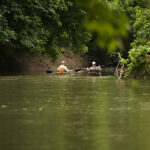
As always, I zipped my PFD and loaded up and followed the growing armada of kayaks heading eastward toward islands and shorelines afar. The shell banks which channel their way under the pier and form a kind of razor sharp pinball cushion, giving a rudderless kayaker a real workout, but by the time I arrived at a distant bank, steering was becoming less an issue. Beaching the kayak on a regular basis, and getting out on the shell banks or islands is a great way to break up the rowing exercise, and keep your cast grooved if you aren’t fond of kayak fly casting from a seated position. I also decided to dispense with the Amas to allow for a longer rowing strokes to cover the distances, but that meant there wouldn’t be any standing in my Tarpon 140 for casting.

The water along the shell banks, and between the islands still felt cold, and I saw boats moving and drifting shallows to the north. So I skirted the shoreline around to keep the calm water and wind break. By now flats boats and air boats were headed for areas well beyond our muscle powered armada. I marveled at the obnoxious sound, and sight of the air boats. They were huge aluminum bottomed boats, some with engines as loud as airplanes. They can go wherever they choose as they are not bound by a lower unit dragging bottoms, and that is a blessing and a curse – actually many curses and a single blessing. The blessing is they don’t plow deep prop furrows into the flats. The curses you probably already know.

As I was making my way around to the north, I saw something floating about fifty yards offshore and about five-hundred yards distant. It was a funky log that floated at that back and front, and back and was sunken at the middle. It was easily twelve feet long … and then it moved. I sat there, stopped paddling, and looked at it. Yup, it moved. More visible, and then submerged, a swish … of the tail. Yup, an alligator just out for a swim, to warm it’s blood in the spring sun and maybe take in a snack or two. Five hundred yards would be just enough … where’s my ‘gator knife? Oh yeah, I didn’t read the part about gators in the chamber of commerce brochures.

I gave the reptile his space, made my way around to the west, stopped at a couple more shell banks to see if I could hit on something in a good north / south marked boat channel running between the shell banks. There was nothing going there, but back off to the east was a large cove, perfectly windless, and the boats and kayaks were starting to move in to it. I knew the kind of bottom there – mud and sand would warm the water more than the channels and shells, and that would draw Reds in as the day warmed on.

Up to this point, I had spent a lot of time working baitfish patterns because there was such a visible abundance of baitfish moving, and I had seen little sign of shrimp, and thought it too early in the year for fish to be keying in on shrimp. But once I beached on the shoreline of the cove, I decided to give a pink and white shallow Clouser a go – it seemed that could bring the best of both worlds – a bait pattern in shrimp colors.

Tomorrow – Fish On! – Redfish in Rockport Part 2

Tweets On The Fly


Fish Feed

Tags of Interest

#flyfishing beaver's bend beer blue river broken bow carp colorado fly fishing denison dam DVD fish art Fish Kill fly fishing fly fishing music fly fishing podcast Fly Rods Fly Tying guadalupe river gulf coast gulf coast fly fishing hybrid bass joel hays kayak fishing laguna madre fly fishers largemouth bass Lefty Kreh Music oklahoma palmetto Photography podcast politics rainbow trout ray roberts redfish rob woodruff south padre island stripers tailwaters texas texoma TFO TPWD weather website design Writing

Earth and Moon

CURRENT MOON

For The Love Of Fishing

Who's Online

  • 0 Members.
  • 9 Guests.

Free Fishing Content